Quick answer
French Bulldogs can overheat quickly because their shortened airways may make panting less effective. Plan walks for cooler conditions, keep activity gentle, provide shade and water, maintain a reliably cool indoor space, and never leave your Frenchie in a parked vehicle.
If overheating or heatstroke is possible, act immediately: move the dog away from heat, begin cooling with cool water or frequently refreshed wet towels plus airflow, offer small voluntary drinks once cooling has begun if the dog is alert, and transport to an emergency veterinarian right away. Do not immerse a French Bulldog in cold water.
Do not wait for collapse, a thermometer reading, or a call back before moving the dog into a cooler environment and starting safe cooling. Heatstroke can injure organs even when a dog appears to improve.
Emergency cooling: what to do now
Suspected heatstroke is a veterinary emergency. Follow this sequence while another person calls the nearest emergency clinic, if possible.
- Stop activity and move away from heat immediately. Carry or calmly guide your Frenchie into shade, air conditioning, or a cool, well-ventilated area. Remove restrictive clothing. Keep the neck and airway free.
- Start cooling with cool water. Pour, spray, or gently sponge cool—not ice-cold—water over the head and body while keeping water out of the nose and mouth.
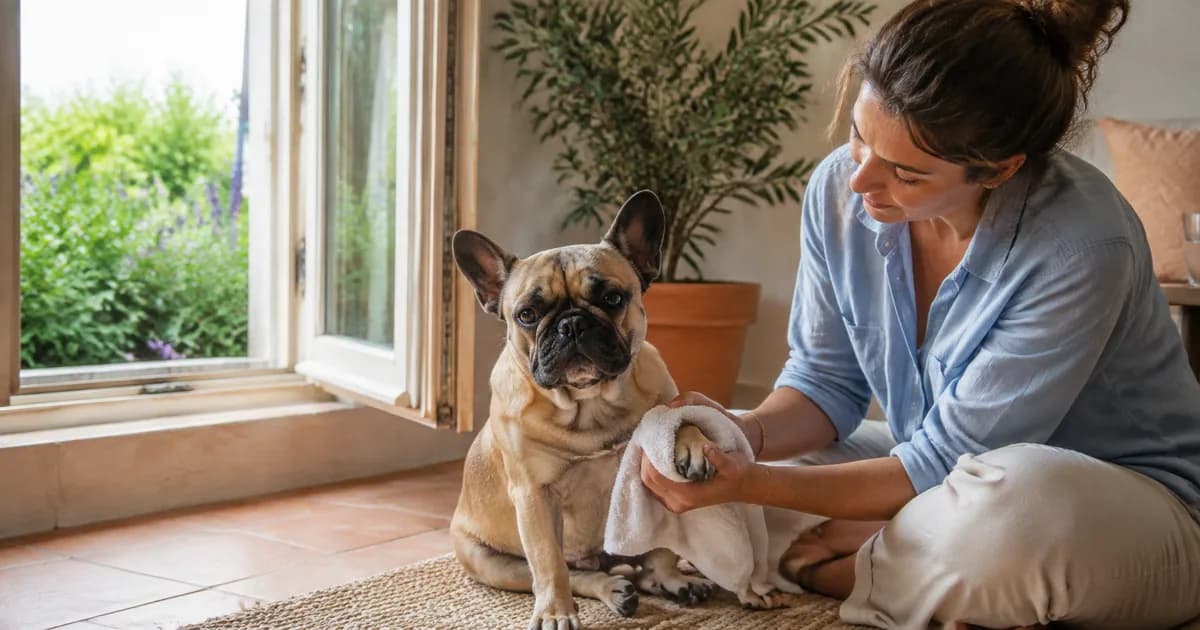
- Use wet towels correctly. Apply cool wet towels to areas such as the belly, chest, inner thighs, and neck. Replace or re-wet them as they warm. Do not tightly wrap the whole dog or leave warmed towels covering the body because they can restrict airflow and trap heat.
- Add airflow. Use a fan, breeze, or vehicle air conditioning across the wet coat. Water plus moving air improves evaporative cooling.
- Offer small amounts of water once cooling begins. Only let an alert dog that can swallow normally take small voluntary drinks. Do not force water into the mouth of a vomiting, confused, collapsed, unconscious, or breathing-compromised dog.
- Transport to emergency veterinary care immediately. Do not stay home waiting for full recovery. Keep the vehicle cool and continue practical cooling and airflow during the journey when it is safe to do so.
Do not use cold-water immersion. Merck Veterinary Manual and AVMA owner first-aid guidance advise against putting an overheated pet into a tub of cold water. Do not apply ice directly over large areas, force the head underwater, give human fever medicine, or delay transport while trying to normalize temperature at home.
Call ahead so the clinic can prepare. Follow its instructions if they differ because the team can account for the dog’s breathing, consciousness, medical history, and the available transport time.
For a deeper explanation of heat-related illness and veterinary treatment, read our French Bulldog heatstroke guide.
Know when heat stress is becoming an emergency
Heat-related illness can progress quickly, and signs may overlap. Do not rely on one symptom or wait for every item in the emergency column.
| What you may notice | What it can mean | What to do |
|---|---|---|
| Panting harder than expected, seeking shade, slowing down, restlessness, increased drooling | Early overheating | Stop activity, move somewhere cool, offer access to water, and watch recovery closely |
| Panting that does not settle, very noisy breathing, reluctance to move, vomiting, diarrhea, weakness, or wobbling | Concerning heat-related illness | Begin cooling and contact an emergency veterinary clinic |
| Confusion, collapse, inability to stand, seizure, loss of consciousness, severe breathing effort, or pale, gray, blue, or purple gums | Life-threatening emergency | Cool immediately and transport to emergency care |
A Frenchie whose breathing becomes louder, harsher, or more labored than usual needs attention even without collapse. Normal-looking gums do not rule out danger, especially when pigmentation or lighting makes color difficult to assess.
Do not struggle with a distressed dog to obtain a rectal temperature. A reading can be useful when safely obtained, but it should never delay cooling, calling, or transport.
Why French Bulldogs need extra summer protection
Dogs release much of their excess heat through panting. French Bulldogs are brachycephalic, meaning their muzzle and skull are shortened. Narrow nostrils, an elongated soft palate, a relatively narrow windpipe, or other features of brachycephalic obstructive airway syndrome (BOAS) can restrict airflow exactly when panting demand increases.
Cornell identifies short-muzzled, older, overweight, and respiratory- or cardiac-compromised dogs as higher-risk groups. A large UK VetCompass study also identified French Bulldogs and brachycephalic skull shape among risk factors for heat-related illness. These population findings cannot predict an individual dog’s safe limit, but they support conservative activity choices.
Risk may be greater when a Frenchie:
- Has noisy breathing, poor exercise tolerance, gagging, or diagnosed BOAS.
- Is overweight or poorly conditioned.
- Is a puppy or senior.
- Has heart, lung, neurologic, or other chronic disease.
- Has previously experienced heat-related illness.
- Is dehydrated from vomiting or diarrhea.
- Is taking medication that may affect temperature regulation or hydration.
- Is excited, stressed, or exercising harder than usual.
Ask a veterinarian to assess persistent snoring, open-mouth breathing at rest, sleep disruption, repeated gagging, heat intolerance, abnormal gum color, or collapse. Those signs should not be dismissed as normal for the breed.
Use a walk decision plan—not one temperature cutoff
There is no universal outdoor temperature that is safe for every Frenchie. Humidity, direct sun, wind, shade, pavement, activity intensity, duration, acclimation, body condition, and airway health all change risk.
Before leaving:
- Check the hourly temperature, humidity, sun exposure, and air-quality alerts.
- Choose the coolest practical part of the day, often early morning.
- Plan a short shaded route with an easy return.
- Carry drinking water, a collapsible bowl, and extra water for emergency cooling.
- Use a comfortable harness that does not press on the throat.
- Skip the walk when conditions or the individual dog are concerning.
During the walk:
- Favor sniffing and calm exploration over running, fetch, or rough play.
- Take breaks before heavy panting begins.
- Watch breathing sound, pace, coordination, and willingness to continue.
- Turn around at the first meaningful change; do not make the dog finish the planned route.
- Keep the outing shorter during the first hot days of a season, when the dog may not be acclimated.
Our Frenchie Heat Risk Checker can help with planning, but it cannot examine your dog or make a risky walk safe. The dog’s breathing and behavior always override a tool result.
Check the ground as well as the air
Asphalt, artificial turf, sand, patios, and car-park surfaces can become much hotter than the surrounding air. Cornell suggests placing a hand or bare foot on the pavement for about 10 seconds; if that is uncomfortable, choose another surface or stay indoors.
Paw protection does not solve the risk of whole-body overheating. If the ground requires boots but the air is hot or humid, indoor activity may be the safer option.
Create a reliable cool zone at home
A fan alone may not be enough in a very hot, enclosed, or humid room. Prepare an area with:
- Air conditioning when available, or good cross-ventilation and monitored room temperature.
- Shade from blinds or curtains during direct sun.
- More than one stable bowl of fresh water.
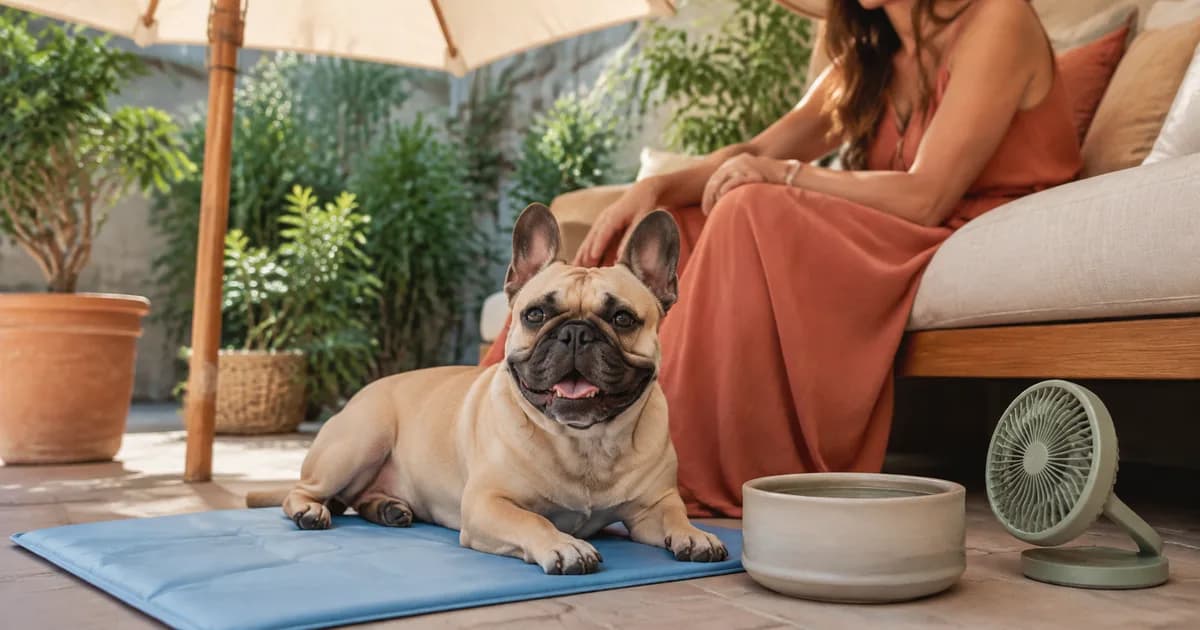
- A cool floor or supervised cooling mat that the dog can move away from.
- No closed conservatory, balcony, garage, crate, or room that can trap heat.
Have a backup plan for a power or air-conditioning failure: another cooled room, a trusted contact, a pet-safe public location, or early relocation before the home becomes dangerously warm.
On high-risk days, substitute calm indoor enrichment for an outdoor workout. Try scent searches, short training sessions, or food puzzles from our French Bulldog indoor-exercise guide. Stop indoor activity too if panting becomes excessive.
Hydration helps, but water does not cancel heat
Offer fresh water before, during, and after activity. Bring a separate supply rather than depending on public bowls or natural water sources. Frequent opportunities to drink are useful, but drinking cannot prevent heatstroke when heat production exceeds the dog’s ability to cool.
Never force water. A dog with severe panting, swallowing difficulty, vomiting, confusion, or reduced consciousness may aspirate liquid. During a suspected emergency, begin cooling and let the veterinary team direct further care.
Car safety is non-negotiable
Never leave a French Bulldog alone in a parked vehicle—not with cracked windows, shade, air conditioning running, or a plan to return quickly. Cornell notes that a car can become dangerously hotter even when the outdoor temperature feels mild, and cracking windows does not prevent the rise.
While traveling:
- Test the vehicle’s climate control before departure.
- Cool the cabin before loading the dog.
- Secure the dog in an appropriate carrier or vehicle restraint without obstructing breathing.
- Keep direct sun off the resting area.
- Carry water and cooling supplies within reach.
- Stop the trip if climate control fails or the dog becomes distressed.
Plan longer journeys with our French Bulldog road-trip guide.
Swimming, sprinklers, and cooling products
Do not assume a French Bulldog can swim. Their body shape and breathing limitations can make water activity difficult. Keep your dog within arm’s reach near pools or open water, use a correctly fitted canine life jacket as an added safeguard, and prevent unsupervised access.
Sprinklers or shallow supervised water play may help some dogs stay comfortable, but excitement can still increase exertion. Stop if breathing changes or the dog becomes tired.
Cooling mats, vests, bandanas, and portable fans are backups—not permission to extend a hot outing. Check product temperature, fit, skin condition, chewing risk, and whether the dog can move away. No cooling product replaces shade, a cool environment, conservative exercise, and observation.
Prepare before the next hot day
Save your regular veterinarian’s number and the nearest after-hours emergency clinic in your phone. Confirm the route and opening arrangements. Keep these supplies ready:
- Drinking water and a bowl.
- Extra clean water for cooling.
- Several clean towels.
- A battery-powered fan if practical.
- A charged phone and vehicle charger.
- Any medical information the emergency clinic may need.
Tell walkers, sitters, and family members that Frenchies may need earlier stopping than other dogs. Show them the emergency sequence and your dog’s normal resting and post-walk breathing pattern.
Frequently asked questions
Should I use ice water on an overheated French Bulldog?
No cold-water immersion. Following Merck and AVMA owner guidance, move the dog to a cooler place and use cool water or frequently refreshed wet towels with airflow while arranging immediate veterinary transport.
Can I wrap my Frenchie in a wet towel?
Use cool wet towels as a cooling aid, especially on less-haired areas, but do not tightly wrap the whole dog. Re-wet or replace towels as they warm and keep air moving across the wet body.
Can a French Bulldog overheat on a mild day?
Yes. Stress, excitement, strenuous activity, humidity, direct sun, poor ventilation, excess weight, and airway disease can reduce a dog’s ability to cope even when the air does not feel extremely hot.
Is heavy panting always heatstroke?
No. Panting can occur after normal activity or excitement. It becomes concerning when it is unusually intense, noisy, or slow to settle, or appears with weakness, vomiting, diarrhea, confusion, abnormal gums, collapse, or breathing difficulty.
Should I still visit a veterinarian if cooling seems to work?
Yes after suspected heatstroke or serious signs. Cooling may improve the visible symptoms before organ, kidney, liver, clotting, or neurologic complications become apparent.
Can a fan keep my Frenchie safe indoors?
A fan supports evaporation when the coat is wet, but moving hot or humid air may be insufficient. Monitor the room, provide water and ventilation, and relocate early if the space cannot stay cool.
Bottom line
Summer safety for a French Bulldog begins before the walk: choose cooler conditions, reduce exertion, provide a dependable cool zone and water, avoid hot surfaces, and remove every parked-car risk. If overheating is possible, move away from heat, begin cool-water or wet-towel cooling with airflow, offer small voluntary drinks once cooling begins, and transport to emergency veterinary care immediately. Do not use cold-water immersion or wait for the dog to collapse.
Sources
- Merck Veterinary Manual: What to do in a dog or cat emergency
- Merck Veterinary Manual: Protecting pets during hot summer months
- Cornell University College of Veterinary Medicine: Heatstroke—a medical emergency
- Cornell University College of Veterinary Medicine: Summer heat safety tips for dogs
- Cornell University College of Veterinary Medicine: Brachycephalic obstructive airway syndrome
- AVMA: Pet First Aid
- Hall et al., 2020: Incidence and risk factors for heat-related illness in UK dogs
This article provides general education, not diagnosis or individualized emergency instructions. If overheating or heatstroke is possible, start safe cooling and contact an emergency veterinarian immediately.