Quick answer
Hip dysplasia is abnormal development and looseness of the ball-and-socket hip joint. The poor fit can damage cartilage and lead to osteoarthritis, pain, stiffness, and reduced mobility. French Bulldogs can develop hip dysplasia, but a bunny-hopping gait or weak back legs does not prove that the hips are responsible.
A veterinarian diagnoses hip dysplasia by combining your dog’s history, gait and orthopedic examination, and correctly positioned hip X-rays. Sedation or anesthesia is usually needed for accurate positioning. Treatment is based on comfort and function—not the X-ray alone—and may include keeping the dog lean, controlled exercise, rehabilitation, veterinary-prescribed pain relief, or surgery. Most affected dogs do not require surgery, but early diagnosis matters because certain procedures are available only before a young dog’s skeleton and arthritis have progressed.
When a mobility change needs urgent care
Hip dysplasia usually causes a gradual or recurring problem. A sudden severe change may be an injury, spinal emergency, dislocation, fracture, or another condition.
| What you see | What to do |
|---|---|
| Mild stiffness, slower rising, or reluctance to jump that persists or returns | Book a veterinary examination soon |
| New limp that does not settle with brief rest, or pain when moving | Contact your veterinarian promptly and restrict strenuous activity |
| Sudden refusal to bear weight, severe pain, a visibly deformed limb, or major trauma | Seek urgent veterinary care |
| Wobbling, knuckling, dragging toes, crossing the hind legs, or inability to stand | Seek urgent care; these can be neurologic signs |
| Loss of bladder or bowel control with weakness or paralysis | Treat as an emergency |
Frenchies are predisposed to spinal disorders as well as orthopedic problems. If weakness, poor coordination, or toileting changes accompany the gait problem, do not assume it is “just the hips.” Our French Bulldog IVDD recovery guide explains why neurologic changes require rapid assessment.
What hip dysplasia actually means
The hip is a ball-and-socket joint. The head of the femur is the ball, and the acetabulum in the pelvis is the socket. In a healthy hip, the structures fit closely and move smoothly. In canine hip dysplasia, the joint develops with abnormal laxity, so the ball moves excessively within the socket.
That instability creates uneven forces. Cartilage can wear and new bone may form around the joint. The resulting osteoarthritis is a major source of long-term pain. Dysplasia develops during growth, but signs may appear in puppyhood or much later as arthritis progresses.
Genetics play a major role, while growth rate, nutrition, body weight, and activity can influence how strongly the disease is expressed. It is not caused by one slippery-floor incident or by an owner allowing one jump. Equally, normal-looking movement today does not guarantee normal hips: some dogs compensate well and show few outward signs.
How common is it in French Bulldogs?
Hip screening and sound breeding decisions matter in French Bulldogs. However, an online database percentage is not the risk for every pet Frenchie. Registries such as the Orthopedic Foundation for Animals receive a self-selected group, and not every radiograph is submitted. Their data help identify breed trends but do not establish population-wide prevalence.
For an individual dog, symptoms, examination findings, and diagnostic imaging are more useful than a breed percentage.
Symptoms at different ages
Young dogs may show discomfort from joint looseness before substantial arthritis is visible. Older dogs more often show stiffness and chronic pain associated with osteoarthritis.
Possible signs include:
- Difficulty rising after sleep or rest.
- Hind-leg stiffness or a shortened rear stride.
- Limping that worsens after activity.
- A “bunny hop,” with both hind legs moving together when running.
- Swaying through the hips while walking.
- Reluctance to climb stairs, jump onto furniture, play, or walk as far as before.
- Shifting weight toward the front legs.
- Reduced thigh muscle on one or both sides.
- Irritability, withdrawal, or resistance to being handled around the rear end.
- Slipping more often on smooth floors.
Signs can be subtle: a dog may avoid stairs, settle slowly, or lose enthusiasm for walks. Chronic pain does not always cause vocalization.
Does bunny hopping mean hip dysplasia?
No. Bunny hopping can occur with painful or mechanically restricted hip movement, but it is not diagnostic. Knee disease, spinal disease, muscle injury, conformational gait, and other problems can produce similar movement. The same applies to limping without crying. See our broader guide to French Bulldog back-leg limping for the main categories a veterinarian considers.
How veterinarians diagnose hip dysplasia
The veterinarian will ask when the change began, whether rest or exercise affects it, and what your dog can no longer do comfortably. Home videos of walking, rising, or using stairs can help when clinic excitement masks a problem.
The veterinarian may:
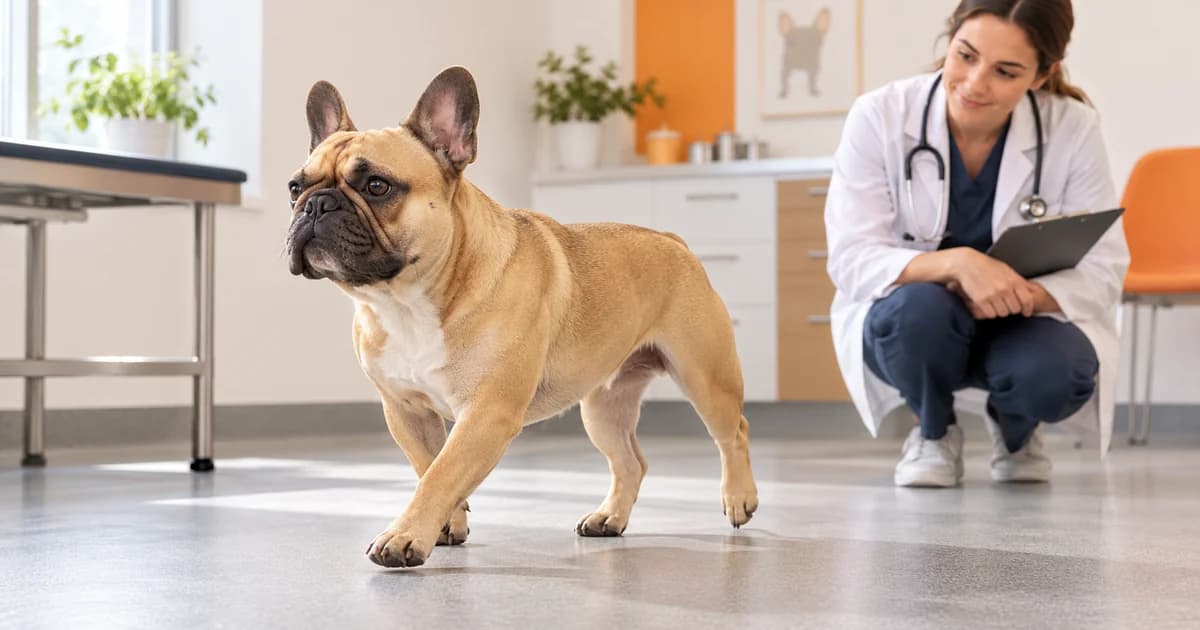
- Watch your Frenchie stand, walk, trot, sit, and rise.
- Feel the spine, pelvis, hips, knees, paws, and surrounding muscles.
- Assess joint range of motion and look for pain, reduced extension, or muscle loss.
- Perform specific laxity tests when appropriate.
- Recommend radiographs and, if neurologic signs exist, a separate neurologic work-up.
Correct hip positioning is essential. Cornell University College of Veterinary Medicine explains that sedation or anesthesia is required for the positioning and palpation used in diagnostic evaluation. Tell the team about your Frenchie’s usual breathing, regurgitation, medications, and any previous anesthesia problems so they can plan appropriately.
PennHIP and OFA are not the same test
- PennHIP uses specialized radiographic views and a distraction index to quantify hip laxity. Certified personnel can evaluate puppies, making it useful when early intervention or breeding decisions are being considered.
- OFA hip evaluation grades the appearance of extended-hip radiographs. Final OFA certification is performed at 24 months or older; younger dogs can receive a preliminary evaluation.
Neither replaces a clinical examination. Imaging can look abnormal in a comfortable dog, while pain can precede dramatic arthritis. Treatment should address the dog, not just the image.
Treatment: how the options compare
| Approach | Best suited to | Main goal |
|---|---|---|
| Lean body condition and controlled exercise | Nearly every affected dog | Reduce joint load and preserve supporting muscle |
| Rehabilitation and home modification | Dogs with weakness, stiffness, or reduced function | Improve strength, movement quality, and daily safety |
| Veterinary pain-management plan | Dogs with clinically meaningful pain or arthritis | Improve comfort using monitored, individualized therapy |
| Joint-preserving surgery | Carefully selected immature dogs before arthritis develops | Improve hip mechanics during growth |
| Femoral head and neck excision | Selected painful dogs when reconstruction or replacement is unsuitable | Remove painful bone-on-bone contact; function relies on a false joint |
| Total hip replacement | Mature dogs with severe pain and appropriate health/anatomy | Recreate a functional ball-and-socket joint |
1. Keep your Frenchie lean
Weight management is not a cure, but it is one of the most important long-term tools. Less excess weight means less force across a painful joint. Ask your veterinarian to assign a body-condition score and target weight rather than relying on a generic breed chart.
You should generally be able to feel the ribs with a light fat covering and see a waist from above, but compact Frenchie anatomy can make visual judgment difficult. Our French Bulldog weight and body-condition guide explains how to combine the scale with hands-on assessment. If weight loss is recommended, use measured portions and veterinary calorie guidance rather than crash dieting.
2. Use consistent, controlled movement
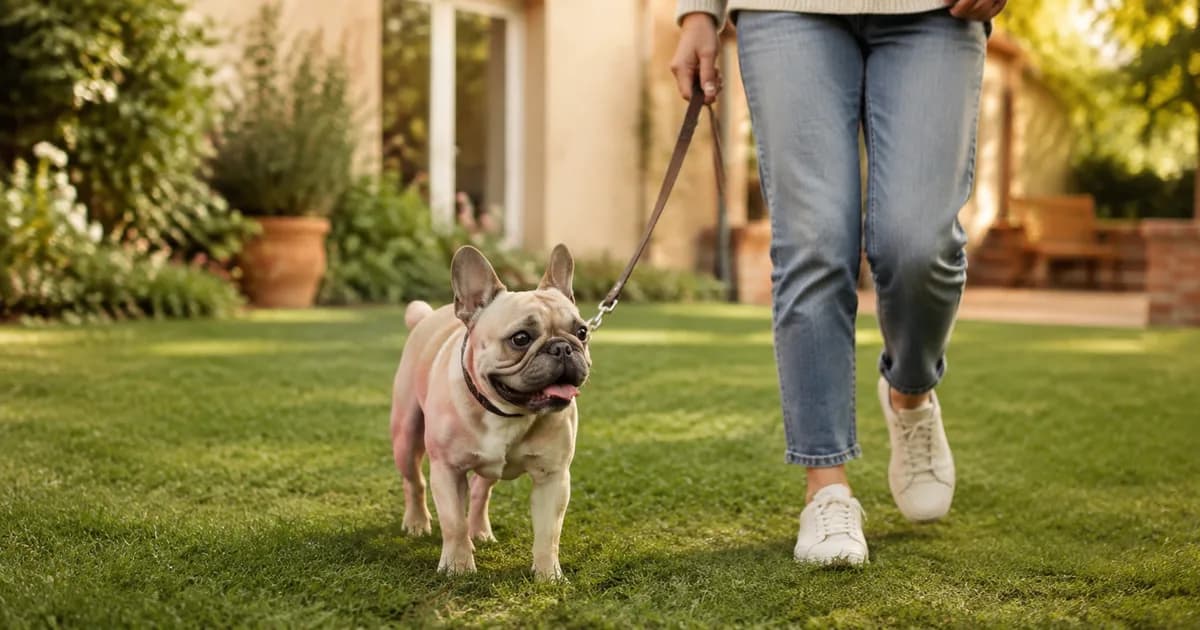
Complete inactivity causes muscle loss and stiffness. Repeated jumping, sharp turns, uncontrolled ball chasing, and hard-ground sprints may provoke pain. Aim for regular low-impact activity adjusted to your dog’s response.
A veterinarian or rehabilitation professional may recommend short leash walks, sit-to-stand work, balance exercises, underwater treadmill sessions, or other targeted activities. Hydrotherapy is not simply recreational swimming, and French Bulldogs should never be assumed to swim safely. Heat and airway limitations also matter; use our Frenchie summer-safety guide when planning warm-weather exercise.
Track how your dog feels later that day and the following morning. More limping, slower rising, or reduced enthusiasm usually means the session exceeded the current plan.
3. Build a monitored medication plan
Veterinarians may use a nonsteroidal anti-inflammatory drug (NSAID) or combine different treatment types for osteoarthritis pain. The choice depends on age, other diseases, current medications, examination findings, and laboratory results. Periodic blood or urine monitoring may be recommended during long-term treatment.
Never give human pain relievers, another dog’s medicine, or leftovers without veterinary direction. Do not combine an NSAID with another NSAID or a corticosteroid unless the veterinarian manages the change. Report vomiting, diarrhea, dark stool, reduced appetite, marked lethargy, increased thirst, or another unexpected change.
Supplements are not interchangeable with proven pain control. Some diets or products containing omega-3 fatty acids may be considered as part of a broader plan, but formulation, dose, evidence, calories, and interactions matter. Ask the veterinarian what measurable benefit to expect and when to stop a product that is not helping.
4. Make the home easier to navigate
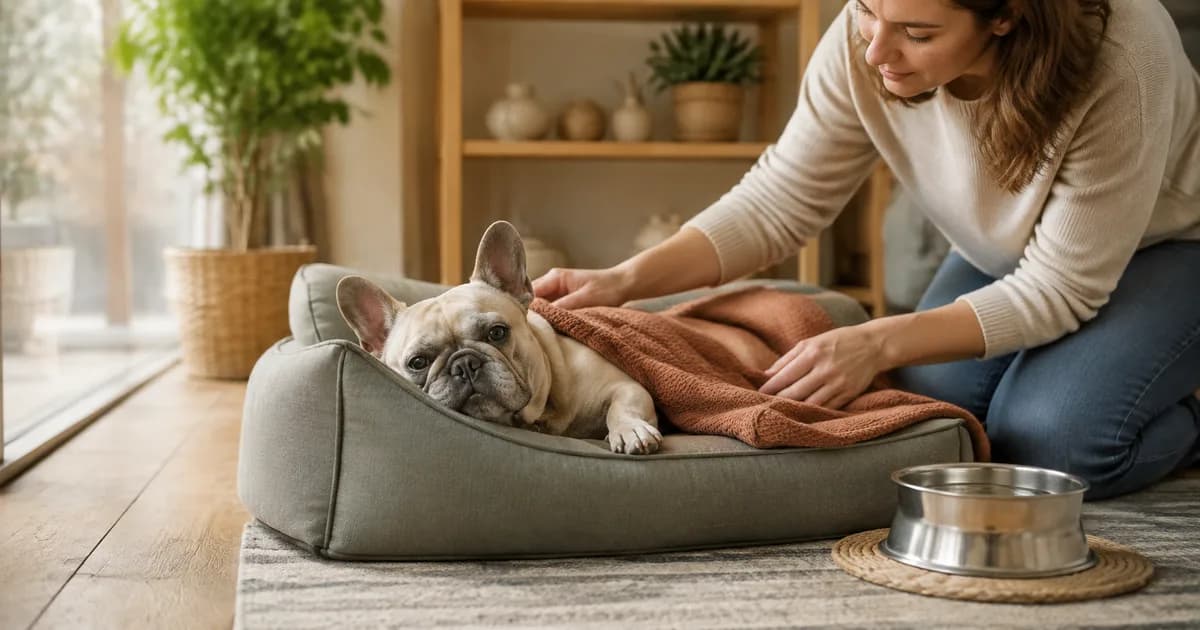
- Place nonslip runners on routes between bed, water, door, and family areas.
- Use a supportive bed in an easy-to-reach location.
- Block repeated jumping from furniture; use a stable ramp only if your dog can use it safely.
- Keep nails and paw hair maintained for traction.
- Use a well-fitted harness for controlled walks, not to lift or drag the dog by the front end.
- Keep food intake consistent; our weight-based feeding guide explains why label amounts are only starting points.
Surgical options and timing
Surgery is not one procedure, and timing can completely change which operations remain possible. Referral to a board-certified veterinary surgeon may be appropriate.
Juvenile pubic symphysiodesis (JPS)
JPS changes growth at part of the pelvis so the socket may rotate into better coverage as the puppy matures. It must be performed at a very young age, after objective laxity testing and before the window closes. Because routine signs may not appear this early, the procedure depends on proactive screening—not waiting for obvious arthritis.
Double or triple pelvic osteotomy (DPO/TPO)
The surgeon cuts and rotates sections of the pelvis to improve coverage of the femoral head. According to the American College of Veterinary Surgeons, candidates are immature dogs, ideally younger than roughly 8–10 months, without radiographic arthritis and with suitable joint anatomy. It is not an option for every loose hip.
Femoral head and neck excision (FHNE or FHO)
The surgeon removes the femoral head and neck, eliminating painful contact within the abnormal joint. Scar tissue and surrounding muscles form a “false joint.” The goal is pain relief, not restoration of normal hip mechanics. Small, lean dogs can be reasonable candidates, but postoperative rehabilitation and muscle strength strongly influence function.
Total hip replacement (THR)
THR replaces both the femoral head and the socket with implants. It is intended to restore more normal, pain-free joint function in mature dogs with severe disease. It requires specialist assessment, strict postoperative restrictions, follow-up imaging, and consideration of infection, implant, fracture, and dislocation risks.
What does surgical recovery involve?
There is no single hip-surgery timeline. Expect a written plan for medication, incision care, confinement, toilet breaks, exercise progression, and rechecks. FHO rehabilitation may encourage motion relatively early; after THR or pelvic osteotomy, protecting the reconstruction is critical. Follow the surgeon’s procedure-specific schedule, not a generic calendar.
Monitoring progress at home
Choose several activities your dog normally performs and score them weekly, such as:
- Time and effort needed to rise from bed.
- Willingness to take a normal walk.
- Ability to use a small number of steps.
- Slipping or stumbling frequency.
- Limping later in the day or the next morning.
- Sleep quality, mood, and interest in play.
A short video in the same location and at the same walking speed can make gradual change easier to see. Share worsening scores with the veterinarian instead of waiting for the next routine visit. Pain plans should be reassessed as the disease, weight, activity, or overall health changes.
Can hip dysplasia be prevented?
Genetic risk cannot be erased after birth, but responsible breeding and growth management can reduce disease burden. Breeding dogs should undergo appropriate hip evaluation, and affected dogs should not be bred. Puppy owners should feed a complete diet formulated for the correct life stage, prevent excess calorie intake and rapid weight gain, maintain a healthy body condition, and provide appropriate—not forced—exercise.
There is no supplement, exercise, floor covering, or feeding trick that guarantees normal hips. Prevention claims should not replace screening or veterinary assessment.
Frequently asked questions
Can a French Bulldog live a normal life with hip dysplasia?
Many affected dogs maintain a good quality of life with individualized management, particularly when pain, weight, strength, and home environment are addressed early. Severity varies widely, and some dogs need surgery to remain comfortable.
Does an abnormal X-ray always mean my Frenchie is in pain?
No. Imaging severity and outward signs do not always match. The treatment decision should combine radiographs with examination findings, daily function, and response to a monitored plan.
Should a Frenchie with hip dysplasia stop exercising?
Usually not. Controlled activity helps preserve muscle and joint motion. The type and amount should be adjusted to pain, airway health, heat, fitness, and any surgical restrictions.
When should I ask for a surgical referral?
Ask early if a puppy has confirmed laxity, because joint-preserving procedures have narrow age and arthritis criteria. In an adult, referral is reasonable when pain remains limiting despite a well-followed conservative plan or when you want to compare FHO and total hip replacement.
Bottom line
French Bulldog hip dysplasia is a developmental joint problem that can progress to painful arthritis, but symptoms alone cannot identify the hip as the source. A full orthopedic—and when needed neurologic—examination plus properly positioned radiographs provides the foundation for treatment. Most dogs begin with lean body condition, consistent low-impact movement, home modifications, rehabilitation, and a monitored veterinary pain plan. Early evaluation protects access to time-sensitive surgical choices, while urgent neurologic or non-weight-bearing signs should never be managed as routine hip stiffness.
Sources
- American College of Veterinary Surgeons: Canine hip dysplasia
- Cornell University College of Veterinary Medicine: Canine hip dysplasia
- Merck Veterinary Manual: Hip dysplasia in dogs
- Merck Veterinary Manual: Osteoarthritis in dogs and cats
- AAHA: 2022 Pain Management Guidelines for Dogs and Cats
- AAHA: 2021 Nutrition and Weight Management Guidelines
- WSAVA: Global Nutrition Guidelines and body-condition tools
- U.S. FDA: Pain medications for pets, including NSAIDs
This article is educational and does not diagnose your dog or replace veterinary care. Seek prompt veterinary advice for pain or a worsening gait, and urgent care for sudden non-weight-bearing lameness or neurologic changes.