Quick answer
A smelly, itchy French Bulldog ear may have otitis externa—inflammation of the outer ear canal—but odor does not prove a yeast infection. Yeast, bacteria, mites, allergy, trapped material, moisture, and other disorders can cause similar redness, discharge, head shaking, and pain. More than one problem may be present at the same time.
Do not pour vinegar, peroxide, alcohol, essential oils, human creams, or leftover drops into an inflamed ear. The eardrum may be damaged, the canal may be ulcerated, and the wrong product can worsen irritation or delay effective treatment. A veterinarian can examine the canal and eardrum and use ear cytology to look for yeast, bacteria, and inflammatory cells. Treatment should match those findings.
Arrange prompt care for a painful, swollen, strongly odorous, or discharging ear. Seek urgent help for loss of balance, falling, abnormal eye movements, facial drooping, a pronounced head tilt, sudden hearing change, or severe pain.
Ear problem triage
| What you notice | Recommended action |
|---|---|
| Mild new odor or occasional scratching without redness or pain | Contact your veterinary clinic for advice before starting a new cleaner |
| Repeated head shaking, redness, discharge, strong odor, or pain when the ear is touched | Arrange a prompt examination; avoid cleaning unless the clinic instructs you |
| Ear flap suddenly swollen like a soft pillow | Seek prompt care; vigorous shaking can cause an aural hematoma |
| Canal looks nearly closed, bleeds, or contains a visible object | Do not probe or flush it; seek veterinary care promptly |
| Head tilt, stumbling, falling, circling, rapid side-to-side eye movements, or facial weakness | Seek urgent veterinary care |
| Marked lethargy, collapse, breathing difficulty, or rapidly worsening illness | Use emergency veterinary care |
What ear odor and itching can mean
The visible ear flap is only the entrance. A dog’s external ear canal extends vertically and then horizontally toward the eardrum, so owners cannot inspect most of it with a flashlight. Otitis externa refers to inflammation within that external canal.
Possible signs include:
- A musty, sour, sweet, or otherwise unusual odor.
- Brown, yellow, cream, black, bloody, waxy, or pus-like discharge.
- Redness, heat, thickened skin, or swelling at the opening.
- Head shaking, scratching, face rubbing, or holding one ear differently.
- Pain when the ear or nearby head is touched.
- Reduced response to sound.
- Restlessness, poor sleep, irritability, or avoidance of handling.
Color and smell are useful observations, not laboratory tests. Dark debris is often described online as mites; brown greasy material as yeast; and yellow-green discharge as bacteria. Those shortcuts are unreliable. Merck Veterinary Manual notes that the yeast Malassezia pachydermatis can exist in low numbers in healthy ears and multiply during otitis. Finding and counting organisms alongside inflammation helps a veterinarian decide whether they are clinically important.
Why French Bulldog ear problems can keep returning
An ear infection is often the visible result of a larger process. A useful veterinary framework separates the problem into three layers:
| Layer | Examples | Why it matters |
|---|---|---|
| Primary trigger | Environmental or food allergy, mites, a foreign object, a mass, or less commonly an endocrine or skin disorder | Starts inflammation and changes the canal environment |
| Secondary overgrowth | Yeast or bacteria multiplying in the inflamed canal | Produces odor, discharge, pain, and more inflammation |
| Perpetuating change | Canal narrowing, thickened tissue, excessive debris, altered glands, resistant organisms, or middle-ear disease | Prevents medication from reaching the target and makes relapse more likely |
In a Frenchie with allergic skin disease, ear inflammation can occur alongside itchy paws, face rubbing, belly or armpit irritation, and recurrent skin infections. That does not mean every Frenchie ear problem is an allergy or that changing food will cure it. Parasites, foreign material, tumors, and other disease still need consideration.
If your dog also has irritated folds, see our French Bulldog skin-fold guide. Chin bumps or pustules may be a separate secondary skin problem; our Frenchie chin acne guide explains when they need examination.
How a veterinarian identifies the cause
1. History and skin examination
The veterinarian will ask whether one or both ears are affected, when the problem began, which treatments were used, whether it returned after medication stopped, and whether itching occurs elsewhere. Tell the clinic about bathing, swimming, grooming, parasite prevention, diet changes, and any medication reactions.
A one-sided sudden problem may increase concern for a foreign object. Disease in both ears plus itchy skin can support an allergic pattern, but neither finding is definitive.
2. Otoscopic examination
An otoscope lets the veterinarian assess swelling, ulceration, debris, foreign material, masses, and—when the canal permits—the eardrum. A very painful or narrowed canal may require pain control, sedation, or initial treatment before a complete view is possible.
The eardrum matters because some products that are acceptable in an intact external canal can damage structures deeper in the ear if the membrane is ruptured. A normal-looking membrane also does not rule out every case of middle-ear disease.
3. Ear cytology
The veterinary team collects material from the canal, stains it, and examines it under a microscope. Cytology can reveal the number and shape of yeast or bacteria and the type of inflammatory response. Ideally, a diagnostic sample is collected before the ear is cleaned so useful evidence is not removed.
Cytology is also valuable at follow-up. An ear may look and smell better before microscopic infection and inflammation have fully resolved. Stopping medication solely because the odor disappeared can contribute to relapse.
4. Additional testing when needed
A bacterial culture and susceptibility test may be considered for certain rod-shaped bacteria, treatment failure, suspected resistance, or middle-ear involvement. Recurrent cases may need evaluation for parasites, allergy, endocrine disease, a mass, or otitis media. Chronic obstructed canals sometimes require imaging, video otoscopy, deep cleaning under anesthesia, or referral to a veterinary dermatologist.
What you can safely do before the appointment
The safest “home treatment” for an undiagnosed painful ear is usually protection and observation—not a homemade antimicrobial.
- Call the clinic before cleaning. Ask whether they want the ear left untouched so cytology can be collected.
- Keep the ear dry. Pause swimming and avoid directing bath water into the canal.
- Prevent self-trauma. If scratching is intense, ask whether an Elizabethan collar is appropriate until the visit.
- Record useful details. Note when signs began, whether one or both ears are involved, recent products, and previous infections. Take a clear photo of the outer ear only.
- Use only current, dog-specific instructions. If your veterinarian has already prescribed a cleaner or medication for this exact episode, follow its label and contact the clinic if administration causes pain, bleeding, or balance changes.
Do not repeatedly wipe away all discharge immediately before the examination. The sample may help identify what is happening.
Why common ear home remedies can be risky
| Product or action | Main concern |
|---|---|
| Hydrogen peroxide or rubbing alcohol | Can sting and irritate an inflamed or ulcerated canal |
| Vinegar or homemade acid mixtures | Concentration is inconsistent; can be painful and may be unsafe when the eardrum is not intact |
| Essential oils | Can irritate tissue, be toxic if absorbed or licked, and do not replace diagnosis |
| Coconut or other oils | Can trap debris, interfere with examination, and are not a reliable treatment for infection |
| Human antifungal or antibiotic cream | Formulation and ingredients are not designed for a dog’s ear canal or uncertain eardrum status |
| Leftover veterinary drops | May target the wrong organism, be contaminated or expired, or be unsafe with a damaged eardrum |
| Cotton swabs inserted into the canal | Can push debris deeper, traumatize the canal, or injure the eardrum |
| Forceful flushing | Can cause pain, worsen trauma, or move material through a damaged eardrum |
“Natural” does not mean non-irritating or ear-safe. If the ear is red, swollen, painful, bleeding, or neurologically abnormal, skip home cleaning and seek care.
How veterinary treatment is chosen
Treatment varies because otitis is not one organism or one severity level. The plan may include:
- Professional cleaning: removes wax and discharge so medication can contact the canal. Severe cases may need sedation or anesthesia.
- Topical medication: may contain an antifungal, antibiotic, and/or anti-inflammatory selected from examination and cytology findings.
- Pain and inflammation control: helps restore comfort and allows examination and topical treatment.
- Systemic medication: may be used in selected complicated cases, including suspected middle-ear disease; it is not automatically required for routine otitis externa.
- Removal of a foreign object or management of a mass: treats the primary mechanical cause.
- Parasite treatment: chosen for the animal and all relevant household pets when mites or another parasite are identified.
- Underlying-disease control: manages allergy or another condition that keeps triggering inflammation.
Use the prescribed amount, frequency, and duration. Ear products are not interchangeable. If two products are prescribed, ask which goes first and how long to wait between them. Contact the clinic rather than forcing medication into a canal that has become more painful or tightly swollen.
Why the recheck matters
A recheck confirms that pain, inflammation, and organisms have resolved and that the eardrum and deeper canal can be assessed when swelling improves. The AAHA allergic skin disease guidelines recommend treating secondary yeast or bacterial infection and otitis while investigating and controlling the underlying itch. This two-track approach helps avoid repeatedly treating only the odor.
The allergy–ear infection connection
Recurring otitis may be one sign of environmental allergy or food allergy. The broader pattern matters: seasonality, paw licking, facial rubbing, recurrent skin lesions, and response to previous therapy can guide the work-up.
Food allergy cannot be confirmed by the brand name, an ingredient list, a blood or saliva test, or a short food switch. A veterinarian-guided elimination diet uses an appropriate hydrolyzed or novel-protein diet fed strictly for a defined period, followed by a food challenge if signs improve. AAHA describes diet trials lasting 4–12 weeks, with a challenge needed to confirm the diagnosis. Read our French Bulldog elimination-diet guide and broader food-allergy resources before assuming chicken, grain, or another ingredient is responsible.
Environmental allergy is usually managed rather than permanently cured. The plan may combine itch control, skin and ear maintenance, parasite prevention, trigger reduction, and possibly allergen-specific immunotherapy. Even with good long-term control, flares can occur and should be assessed early.
Routine cleaning after the ear is healthy
Not every French Bulldog needs scheduled ear cleaning. Over-cleaning can irritate a healthy canal. Your veterinarian should choose the product and frequency based on wax production, previous disease, eardrum status, and whether the dog swims or receives topical ear therapy.
When your veterinarian has confirmed that cleaning is appropriate:
- Use the recommended veterinary ear cleaner at room temperature.
- Lift the ear flap and apply the instructed amount without touching the bottle tip to the ear.
- Gently massage the base of the ear only if this is comfortable.
- Let your dog shake their head.
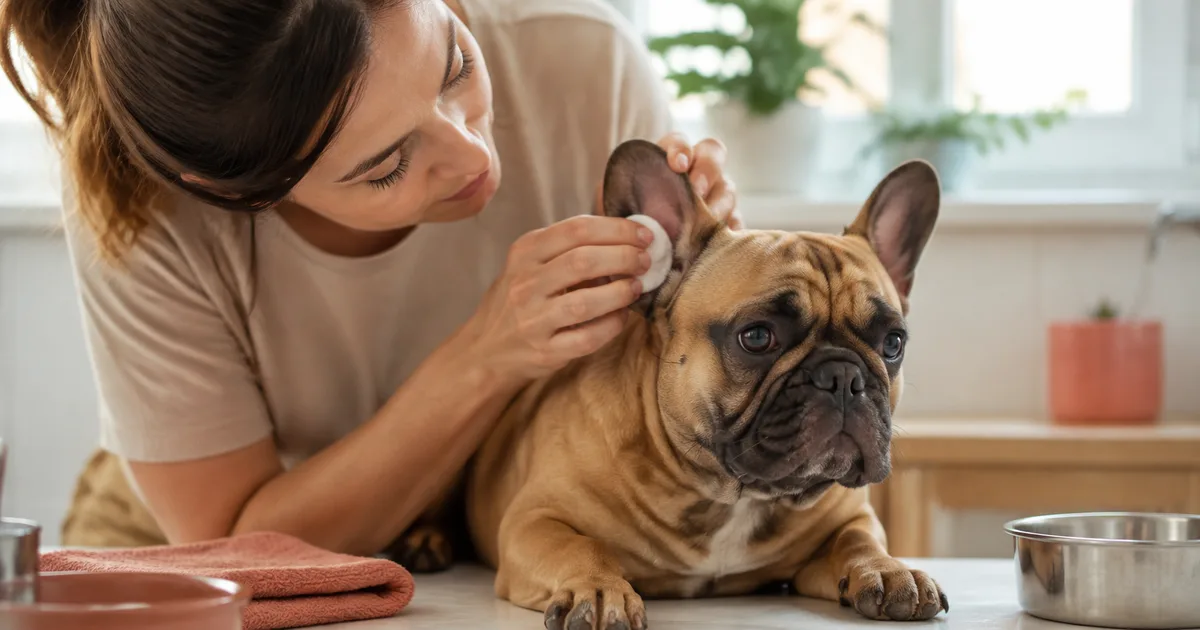
- Wipe material from the ear flap and visible entrance with gauze or a cotton pad.
- Never insert a swab or your finger beyond what you can clearly see.
- Stop and call the clinic if cleaning causes pain, bleeding, marked resistance, dizziness, or worsening signs.
Do not pluck ear hair routinely unless your veterinarian or groomer, working from veterinary advice, has identified a reason. Unnecessary plucking can create inflammation and tiny injuries.
Preventing another flare
- Check both ears weekly for a change from your dog’s normal odor, wax, color, or comfort.
- Keep ears dry after bathing and avoid moisture entering the canals.
- Follow the prescribed maintenance schedule instead of cleaning whenever an ear “looks dirty.”
- Maintain veterinarian-recommended flea and mite prevention.
- Continue the allergy plan even after the ear improves.
- Return for cytology or examination when advised; do not stockpile unfinished drops.
- Seek reassessment when episodes recur quickly, always affect the same ear, or stop responding to a previously effective treatment.
Explore our French Bulldog skin-health section for related guidance, but remember that a skin or food guide cannot substitute for looking into the ear canal.
Frequently asked questions
Can I tell yeast from bacteria by the smell?
No. Odor and discharge overlap, and mixed infections occur. Cytology is the practical test used to see organisms and inflammation under a microscope.
Are French Bulldog ear infections contagious?
Typical yeast or bacterial overgrowth secondary to inflammation is not usually treated as contagious between healthy dogs. Ear mites can spread between pets, however, so the diagnosis changes what household management is needed.
Can I clean the ear before the veterinary visit?
Ask the clinic. Cleaning can remove material needed for cytology, and flushing a painful ear with an unknown eardrum status may be unsafe. Gently wiping only the outside of the flap is different from putting liquid into the canal.
Why did the infection return after drops worked?
Possibilities include incomplete resolution, incorrect administration, resistant organisms, medication not reaching a narrowed canal, middle-ear disease, or an uncontrolled primary trigger such as allergy. A repeat examination and cytology are more useful than automatically reusing the same drops.
When should I request a specialist?
Discuss referral to a board-certified veterinary dermatologist when infections are chronic, recur soon after appropriate treatment, involve resistant organisms, require repeated anesthesia, or have caused marked canal narrowing. A one-sided persistent problem or suspected mass also warrants deeper investigation.
Bottom line
French Bulldog ear odor and itching are signs, not a home diagnosis of yeast. Prompt otoscopy and cytology allow treatment to target the organisms and inflammation actually present. Until the ear has been examined, keep it dry, prevent scratching, and avoid homemade solutions or leftover medication. For recurring otitis, lasting improvement usually requires two jobs at once: clearing the current ear disease and controlling the allergy, parasite, foreign material, or chronic canal change that allowed it to return.
Sources
- Merck Veterinary Manual: Otitis externa in animals
- Merck Veterinary Manual: Otitis media and interna in animals
- Merck Veterinary Manual: Ear infections and otitis externa in dogs
- AAHA: 2023 Management of Allergic Skin Diseases Guidelines
- AAHA: Diagnosing allergic skin disease in dogs
- VCA Animal Hospitals: Ear infections in dogs
- VCA Animal Hospitals: Ear cleaning and medication in dogs
- American College of Veterinary Dermatology: Find a veterinary dermatologist
This article is educational and does not diagnose your dog or replace veterinary care. Ear pain, discharge, neurologic changes, and repeated infections require advice based on an examination.