
Quick answer
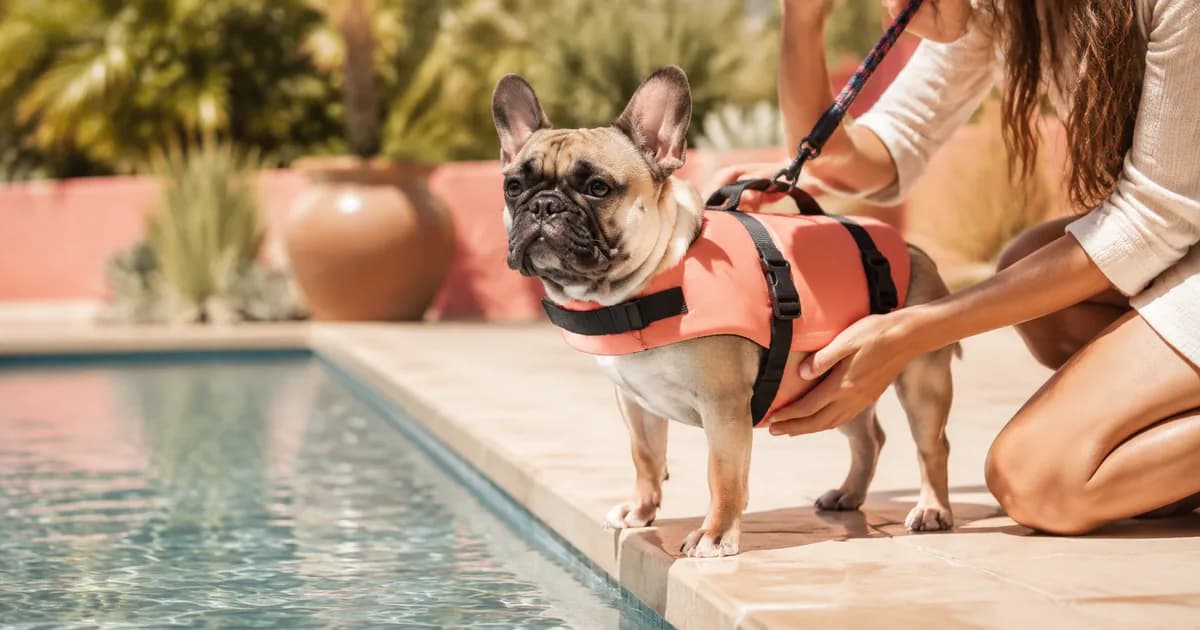
French Bulldogs are not a breed to trust around water. Their short muzzle and front-heavy build can make swimming and keeping the head above water difficult. Some dogs may paddle, but ability varies and tiredness can become dangerous quickly. Never assume a Frenchie can swim, and never leave one unattended near a pool, lake, river, or the sea.
VCA advises extra care with flat-faced dogs because they may tire more quickly while swimming. The American Kennel Club also describes French Bulldogs as poor swimmers that can drown easily. VCA water-safety guidance, AKC French Bulldog guidance.
Safer water rules
- Stay within arm's reach and keep your attention on the dog.
- Use a well-fitted dog life jacket with flotation, visibility, and a sturdy handle.
- Introduce the jacket on land and stop if your dog is distressed.
- Start in shallow, calm water only if your veterinarian agrees that swimming is suitable.
- Give frequent breaks; swimming is tiring even for experienced dogs.
- Keep your dog away from fast currents, large waves, riptides, ice, and thunderstorms.
- Provide fresh drinking water so your dog does not drink pool, lake, river, or sea water.
- Rinse your dog after swimming and do not swim with an open wound or healing incision.
A life jacket is a safety layer, not permission to swim alone. VCA recommends a life jacket for large bodies of water and says dogs should never swim unattended. Read VCA's full swimming guidance.
Pools need a way out
Dogs can fall into a pool and fail to find the exit even when they have previously swum. Use a secure barrier and a self-closing gate, keep the water area supervised, and install a ramp or steps that your dog can actually use. Practice the exit with positive reinforcement while the pool is empty or under controlled conditions.
Do not describe any pool cover, shallow pool, or water depth as completely risk-free. A Frenchie can slip, become exhausted, inhale water, or be unable to climb out. Barriers and supervision work together; one measure is not enough.
Signs your dog is struggling
Leave the water immediately if your Frenchie is tiring, panicking, coughing, swallowing water, struggling to keep the head up, or unable to reach the exit. Afterward, seek veterinary advice for persistent coughing, breathing changes, weakness, vomiting, unusual sleepiness, or any concern that water was inhaled.
Breathing difficulty, blue or pale gums, collapse, or unconsciousness is an emergency. Call the nearest veterinary hospital and follow its live instructions. Do not put your fingers into the mouth of a conscious, frightened dog. The AVMA explains that choking and non-breathing emergencies require careful first aid and immediate veterinary transport. AVMA Pet First Aid.
If a dog is unconscious and not breathing, use current veterinary first-aid guidance or the emergency hospital's instructions while someone arranges transport. Do not rely on a generic online CPR script: positioning and rescue-breathing technique depend on the dog's size, chest shape, condition, and whether an airway obstruction is present.
Is water play safer than swimming?
Supervised splashing in a stable, shallow setup may be lower risk than deep water, but it is not risk-free. Keep the dog away from slippery edges, standing water that may become contaminated, and jets directed at the face. Never force a dog into water or use swimming as exercise without veterinary guidance.
Professional hydrotherapy should be arranged through a veterinary rehabilitation service. The therapist can decide whether the water, equipment, and exercise are appropriate for that individual dog.
This article is educational information, not a diagnosis or emergency treatment plan. FrenchieCheck cannot assess swimming ability, airway effort, or whether a dog has inhaled water online.
Related guides: French Bulldog Heat Stroke, Is My French Bulldog Breathing Normal?, French Bulldog Harness Safety