Quick answer
The best trick is the one your individual Frenchie can learn comfortably and enjoy. This list is a practical ranking by setup and physical demand, not a scientific breed-wide ranking. Use reward-based training, keep sessions short, and stop if your dog shows stress, pain, overheating, breathing difficulty, or loss of balance.
Avoid jumping, repeated hard landings, forced positions, and long sessions. A dog can be mentally engaged without being pushed into strenuous movement.
Before you start
Choose a non-slip surface, small rewards, and a quiet place. Use a marker word such as “yes” or a clicker, followed immediately by the reward. Let your dog move voluntarily; do not drag, push, roll, or hold them in position.
Start with the easiest version of a behavior, reward small progress, and increase difficulty gradually. If your Frenchie has pain, mobility problems, a history of back or joint issues, recent surgery, or breathing concerns, ask your veterinarian which activities are appropriate.
1. Touch a hand target — easiest starting point
Hold an open hand a short distance from your dog’s nose. When they investigate or touch it, mark and reward. Move the hand gradually so your dog follows it around a room, then add a cue such as “touch.”
This behavior can become a useful way to guide your dog without pulling on a collar. Keep the hand target low and comfortable; never use it to force a dog toward something frightening.
2. Shake or high five — simple paw behavior
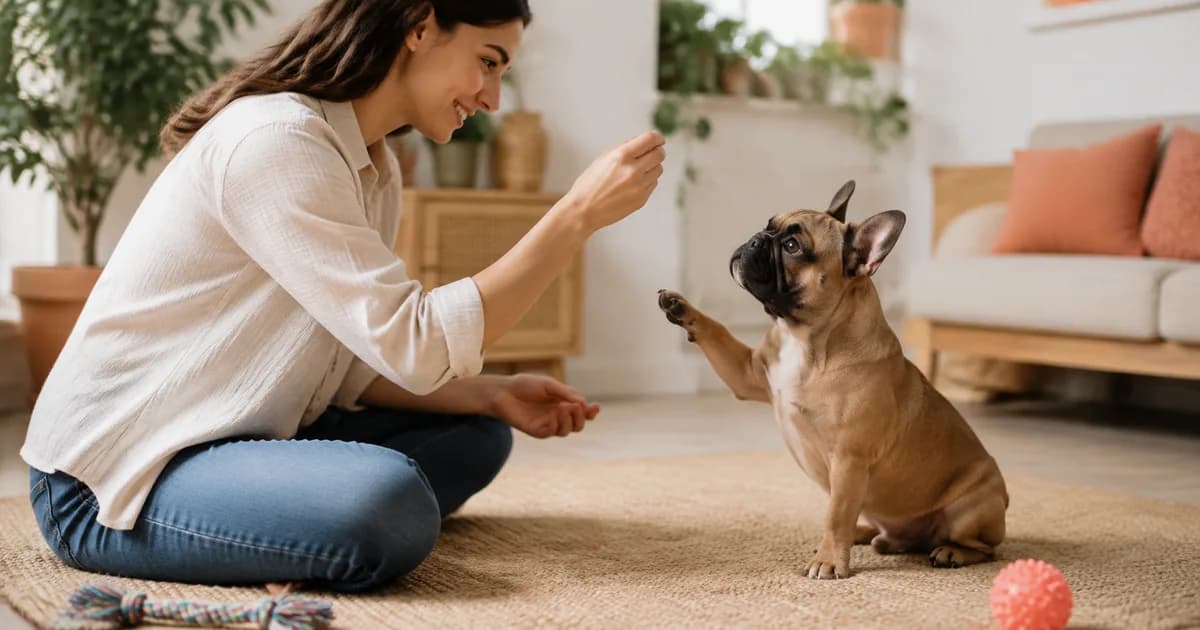
Reward a voluntary paw lift, then present your hand as the target. Once your Frenchie offers the paw reliably, add the cue before presenting your hand. For a high five, raise the target gradually and stop if the dog loses balance or dislikes the movement.
Do not grab or pull the paw. Dogs differ in coordination and preference, and either paw is fine.
3. Settle on a mat — useful everyday skill
Reward your dog for looking at, stepping onto, and relaxing on a mat. Add a release cue so they understand when the behavior ends. Gradually practice while you sit nearby, then with mild household distractions.
This is not a stay contest. Reward calm choices and release before your dog becomes frustrated. A mat behavior can help with visitors, grooming preparation, or quiet time, but it is not a treatment for anxiety.
4. Spin — keep the movement small
Use a treat or hand target to guide one slow, comfortable turn. Mark the completed turn, then gradually reduce the lure and add a cue. Stop if your Frenchie wobbles, becomes disoriented, pants unusually, or resists.
Do not demand repeated or fast spins. Dogs with a history of back, joint, balance, or mobility problems should be cleared by a veterinarian first.
5. Play dead — optional and comfort-led
Teach a down first, then reward a natural shift toward the hip or side. Add the cue only when the movement is voluntary. A comfortable hip-roll or head-down position can be a complete version; the dog does not need to lie perfectly flat.
Never physically roll your Frenchie or hold them down. Use a padded, non-slip surface and stop if the dog shows discomfort. This trick is optional; a dog that dislikes side-lying can learn another behavior instead.
A simple training pattern
- Ask for an easy behavior first.
- Mark the smallest correct movement.
- Reward promptly.
- Take a pause before the next repetition.
- End while your dog is still engaged.
- Practice in a new place only after the behavior is comfortable at home.
Food is not the only reward. Praise, play, sniffing, or access to a favorite toy may be more useful for some dogs.
What to avoid
Do not use shock, prong, choke, physical corrections, intimidation, or forced positioning. Do not treat a dog’s refusal as proof of stubbornness; pain, confusion, fear, fatigue, or an overly difficult step can look like refusal.
The American Veterinary Society of Animal Behavior recommends reward-based training for canine training and behavior problems.
When to pause or ask for help
Stop the session for persistent panting, coughing, breathing difficulty, trembling, repeated lip licking, hiding, limping, pain, wobbling, or loss of interest. Ask your veterinarian about sudden changes or physical concerns. A qualified reward-based trainer can help break a trick into smaller steps.
Bottom line
Choose low-impact tricks, reward voluntary movement, and adapt the picture to your Frenchie. The goal is clear communication and a positive experience, not a fixed performance or a race against the clock.
Sources
- American Veterinary Society of Animal Behavior: Humane Dog Training Position Statement
- American Veterinary Society of Animal Behavior: How to Choose a Trainer
- American Kennel Club: Training with rewards and positive reinforcement
This article is educational information. It does not diagnose pain, anxiety, breathing problems, or other health conditions.