
Quick answer
Potty training is a learning process, not a fixed deadline. Progress varies with age, previous routines, health, living arrangements, supervision, and how consistently the household responds. The most reliable approach is to provide frequent opportunities in the right place, supervise closely, reward immediately after success, and clean accidents without punishment.
Puppies usually need more opportunities than adults, especially after waking, eating, drinking, playing, and exciting activity. An adult dog that suddenly starts having accidents should be checked by a veterinarian rather than treated as disobedient.
Set up one clear toilet area
Choose an outdoor spot that is practical and safe, or a consistent indoor toilet area if that is the plan for your home. Keep the route easy to reach and use the same cue each time, such as “go potty.” If you use pads, do not move them repeatedly while your dog is learning.
Ask your veterinarian about safe outdoor access for a puppy whose vaccination plan is not complete. Local disease risks and the puppy’s individual plan matter.
Build a predictable routine
Take your dog to the toilet area:
- immediately after waking;
- after meals and substantial drinking;
- after naps, play, and training;
- before bedtime;
- whenever you notice sniffing, circling, restlessness, or moving toward the usual area.
Young puppies may need very frequent opportunities. Do not copy a universal “hold it” rule from the internet; the right interval depends on the individual dog. If your schedule makes supervision impossible, arrange a responsible person to provide a break or use the indoor plan your veterinarian or trainer considers appropriate.
Supervise between breaks
When your dog is loose, keep them near you, use a gate, or use a safe pen so you can notice early signals. If you cannot supervise, use a comfortable, appropriately sized resting area that the dog already associates with safety. A crate should never be used as punishment, and it should not be used for longer than the dog can comfortably manage.
The goal is to prevent repeated accidents while teaching the correct location. It is not to make the dog endure discomfort.
Reward the behavior you want
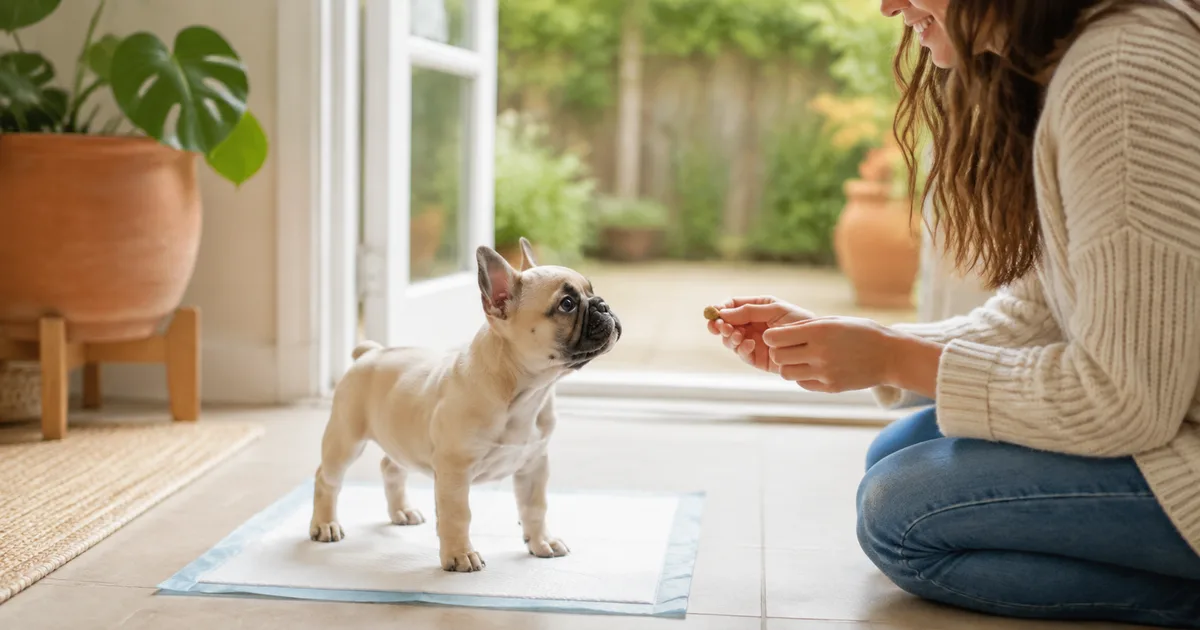
Bring a small reward with you. When your Frenchie finishes in the correct place:
- wait until elimination is complete;
- mark the moment with calm praise;
- give the reward immediately, while you are still at the toilet area;
- allow a brief calm activity afterward so the dog does not learn that toileting instantly ends all outdoor time.
Use a reward your dog values, but keep food portions small and account for them in the daily diet. Praise, play, and access to a favorite activity can also be useful.
Handle accidents calmly
If you see your dog beginning to eliminate indoors, interrupt gently without frightening them and take them to the correct place. Reward them if they finish there.
If you discover an accident later, say nothing to the dog. Clean the area thoroughly with a product that removes odor, and review the supervision and break schedule. Do not rub the dog’s nose in the mess, yell, hit, or punish after the event; the dog cannot connect a later punishment with the earlier accident, and fear can make training harder.
Crate and pen use
A crate can support house training when it is introduced positively and used as a resting place. Provide enough room for the dog to stand, turn, lie down, and stretch comfortably. Puppies and dogs with medical or anxiety-related needs may not be able to wait as long as an adult dog.
If your dog soils the crate repeatedly, review the size, schedule, stress level, feeding and drinking pattern, and health with a veterinarian or qualified trainer. Do not simply increase confinement.
Indoor pads and apartment living
Pads, an indoor toilet, or a balcony system can be practical when outdoor access is limited. The trade-off is that the dog must learn which indoor surface is allowed. Use one consistent location, reward correct use, and transition gradually if you later want outdoor-only toileting.
Do not make your Frenchie wait in dangerous heat, cold, or weather. A veterinarian or trainer can help you choose a plan that fits the home and the dog.
When accidents continue
Arrange a veterinary check if accidents are sudden, frequent, painful, associated with increased thirst, straining, diarrhea, blood, weakness, or if a previously trained adult regresses. Stress, schedule changes, fear, pain, urinary or digestive problems, and other health issues can all affect house training.
What progress looks like
Look for fewer accidents, more predictable signals, and quicker success in the chosen area. A setback does not mean the dog has failed; return to closer supervision and more frequent opportunities, then build freedom gradually.
Avoid judging progress by a fixed number of days or months. If there is no improvement despite a consistent plan, ask for help instead of increasing punishment or confinement.
Bottom line
Potty training works best as a calm routine: give frequent chances, supervise, reward immediately, clean accidents thoroughly, and investigate sudden changes. Your Frenchie is learning a location and a habit; they are not being “stubborn” for having an accident.
Sources
- American Kennel Club: How to Potty Train a Puppy
- American Kennel Club: Housetraining Dogs
- American Veterinary Society of Animal Behavior: Humane Dog Training Position Statement
This article is educational information. It does not diagnose urinary, digestive, behavioral, or other health problems.